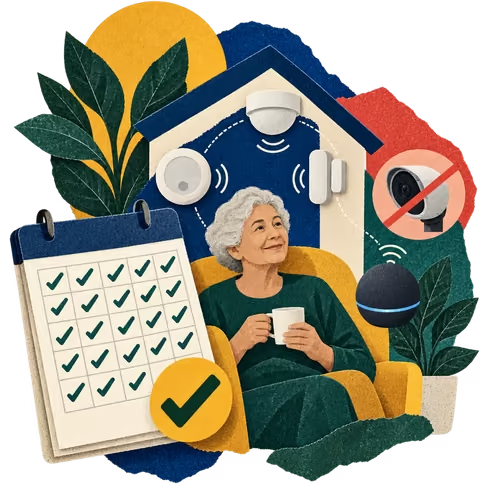
Feeling in control of data and trust were linked through understanding
Among 68 Brazilian students who tested a simulated smart building, control and trust were linked through privacy awareness, not directly.

The key idea
Feeling in control of data was associated with better understanding the risks of sharing it, and that understanding was associated with greater trust.
The study, in plain language
A connected-home platform can promise that each person decides which data to share. In Brazil, students tested a tool for reviewing data permissions in a simulated smart-building scenario, then described how they understood control and privacy.
Those who felt more in control also tended to say they better understood the risks of disclosing information and the consequences of sharing it. That understanding, in turn, was associated with greater trust in the platform.
Perceived control and transparency did not by themselves show a clear direct link with trust. The path connecting the responses ran through better understanding what could happen to the data.
What they found
- Feeling more in control was associated with greater perceived transparency and privacy awareness.
- Privacy awareness was associated with greater trust. Control and transparency had no direct links with it.
- The analysis found an indirect path between control and trust through privacy awareness, without establishing cause and effect.
Something to think about
If a platform lets you decide which data to share, does that make you trust it more, or do you first need to understand what could happen to them?
How they studied it
The researchers evaluated a personal-data storage and permissions platform in a simulated smart-building scenario. After using it, 68 undergraduate and graduate students at a Brazilian university answered questions about control, privacy, and trust. Because the study measured associations after the test, it does not show that control caused greater trust.
What the study cannot show
- A university sample in Brazil, likely with above-average digital knowledge; a simulated smart-building scenario and a questionnaire after brief interaction; no test of prolonged use, real-world deployment, or technical reduction in data leaks. The article itself cautions that the sample may not represent users with less experience using digital tools.
- Whether FoT-PDS reduces privacy incidents in real systems, whether perceived control is equivalent to effective protection, or whether the model’s associations are causal or generalizable to the whole population.
The original study
My data, my rules: an experimental study on a user-centric approach to data privacy in the internet of things
Source under CC BY 4.0. English adaptation and explanation by PaperFlow, with AI assistance. The text has been reorganized for a general audience; it is not the complete paper and does not imply endorsement by its authors.
One study alone does not represent a field's consensus. Educational content does not replace professional advice. Report a possible error.