Exercise, challenges, and social activity improved a memory test
Older adults with mild cognitive impairment were randomly assigned. The program group improved on a memory-and-thinking test while the routine group declined.
The key idea
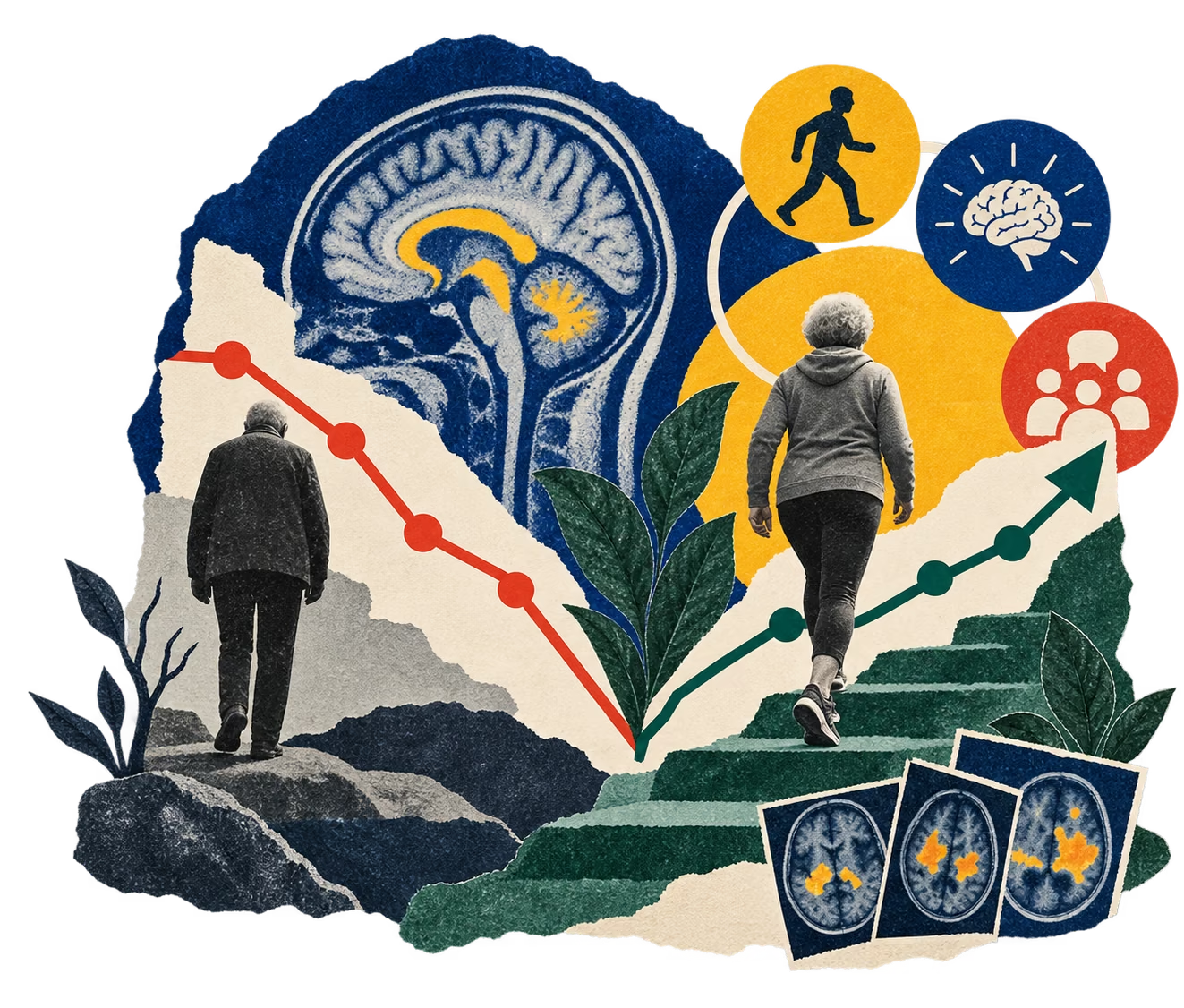
The program improved one cognitive test and increased blood flow near memory areas. Brain-tissue loss did not show a change.
The study, in plain language
Movement, mental challenges, and shared activities were parts of one program for older adults with mild cognitive impairment. The team randomly assigned participants either to follow it for seven months or continue their usual routine.
At the end, the program group had improved on a memory-and-thinking test, while the other group had worse results. Blood flow near memory-related regions also increased. Brain-tissue loss, however, showed no detectable reduction with the program.
What they found
- On the memory-and-thinking test, the program group improved while the routine group declined.
- Blood flow increased in an area near memory-related regions.
- No reduction in brain-tissue loss was detected.
Something to think about
Think of an ordinary week: how much room is there for movement, a difficult mental task, and time with other people? This study combined all three, so it does not show which mattered most.
How they studied it
The team randomly assigned older adults with mild cognitive impairment to a program combining exercise and mental and social activities or to continue their usual routine. Over seven months, they measured mental abilities, blood flow, and brain images.
What the study cannot show
- The comparison group did not receive an equivalent activity, and the program combined several components. There was attrition and fewer participants in some brain analyses.
- The study does not show that the program prevents dementia, reverses decline, or that exercise or mental tasks alone would produce the same result.
The original study
Randomized trial on the effects of a combined physical/cognitive training in aged MCI subjects: the Train the Brain study
Source under CC BY 4.0. English adaptation and explanation by PaperFlow, with AI assistance. The text has been reorganized for a general audience; it is not the complete paper and does not imply endorsement by its authors.
One study alone does not represent a field's consensus. Educational content does not replace professional advice. Report a possible error.