The full app reduced drinking by about two and a half more drinks per week
Among 761 Canadian adults with risky drinking, reported drinking fell with both versions. It fell somewhat more with the full version.
The key idea
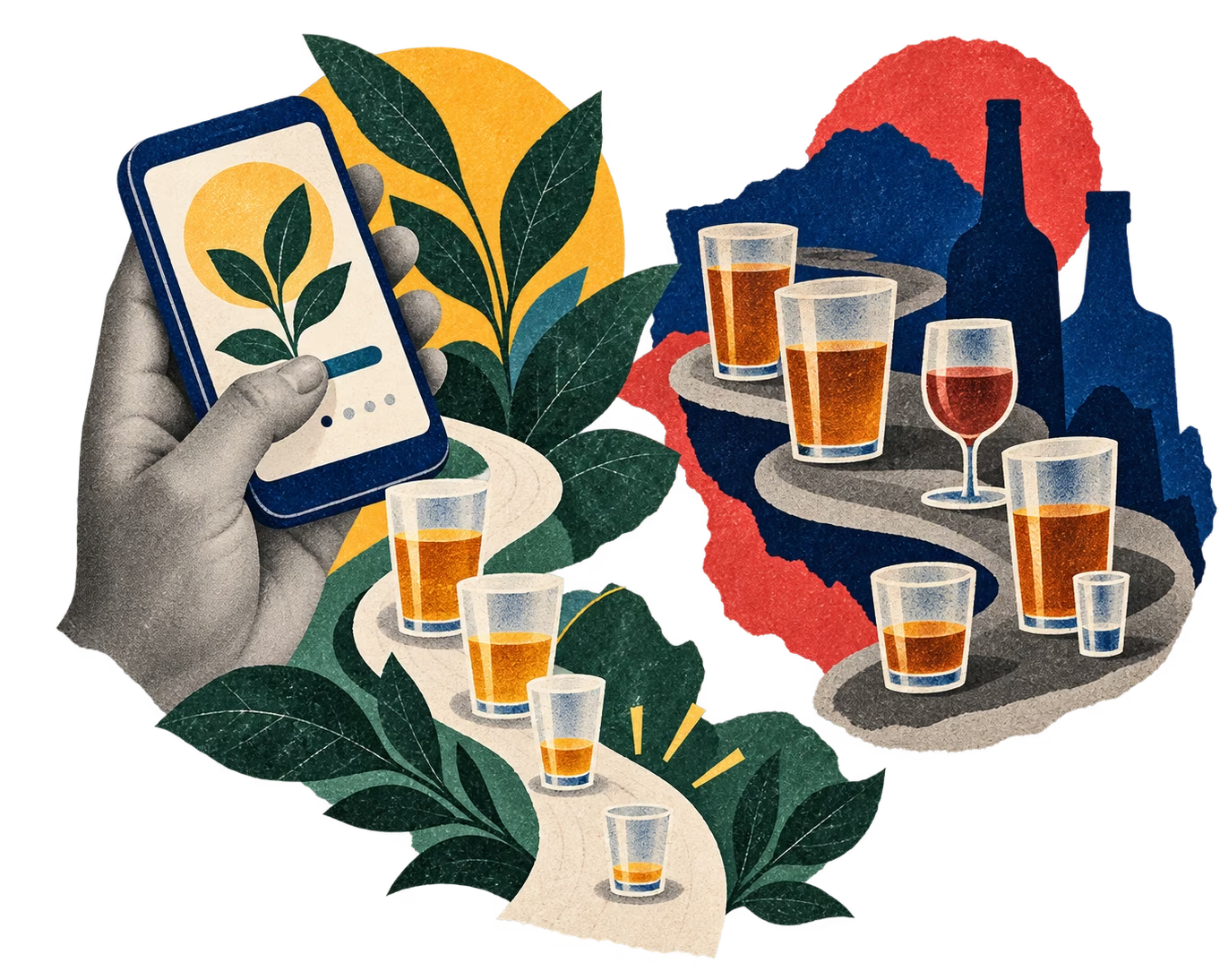
Both versions were associated with lower self-reported drinking. The full version showed a somewhat larger reduction, but not in heavy-drinking days or alcohol-related problems.
The study, in plain language
An app can offer different levels of support for changing alcohol use. Here, adults with risky drinking were randomized to a full version or one with educational information. Neither they nor the team knew which version each person received, and responses were followed for six months.
People who used the full version reported a greater reduction in drinks per week: about ten fewer on average, compared with nearly eight fewer with the educational version. There was no firm difference between the versions in heavy-drinking days or alcohol-related problems. Participants reported all the measures themselves, and nearly one in five did not complete follow-up.
What they found
- Both groups received an app: one full version and one offering educational information only.
- The full app produced a larger reduction in the number of drinks per week reported by participants.
- There was no firm difference in heavy-drinking days or alcohol-related problems.
Something to think about
If you are considering an app to change a habit, what does it include: information alone or something more? Here, the full version added something in weekly quantity, but not in heavy-drinking days.
How they studied it
In Canada, 761 adults with risky drinking and smartphone access were randomized to a full app or an educational version. Neither participants nor the team knew which version each person received. They were followed for six months.
What the study cannot show
- Follow-up was incomplete for 19%; both groups received an app and content, so the comparison does not measure an effect versus no intervention. The primary outcome was based on self-reported drinking and was followed for only six months.
- It does not establish efficacy for severe alcohol use disorder, prevention of clinical harms, or equivalence to professional treatment. It also does not identify which app module produced the change.
The original study
Randomized controlled trial of a smartphone app designed to reduce unhealthy alcohol consumption
Source under CC BY 4.0. English adaptation and explanation by PaperFlow, with AI assistance. The text has been reorganized for a general audience; it is not the complete paper and does not imply endorsement by its authors.
One study alone does not represent a field's consensus. Educational content does not replace professional advice. Report a possible error.